
Mass arbitration and class actions often involve the same companies, but they are not the same legal process. Here is how mass arbitration can remain an option even after a class action deadline has passed.
Education
Know Your Rights

Many people first hear about consumer claims through a class action notice, an email, or an online alert. Later, they might see an ad about a mass arbitration involving the same company and assume it must be for that class action, but it usually isn't.
Mass arbitration and class actions are different legal processes, even when they involve the same company or similar obligations. Companies who have caused harm to consumers may continue facing individual claims for the same, or similar patterns of harm long after a single class action lawsuit has ended. This often occurs through mass arbitration.
Read our article on Mass Arbitration here: Mass Arbitration 101: What It Is and How It’s Different From a Class Action.
Mass Arbitration vs. Class Actions: Often Not the Same Case
A class action is a single lawsuit filed in court on behalf of a large group of people. If you miss the deadline to join yourself to that group, your participation in that specific lawsuit may be closed.
That doesn't mean the door to other arbitration is closed. The mass arbitration process specifically involves individual claims brought under arbitration clauses in consumer contracts, usually outside of court. Claims brought under this legal process are individualized, and ruled on separately, even though many are filed at the same time.
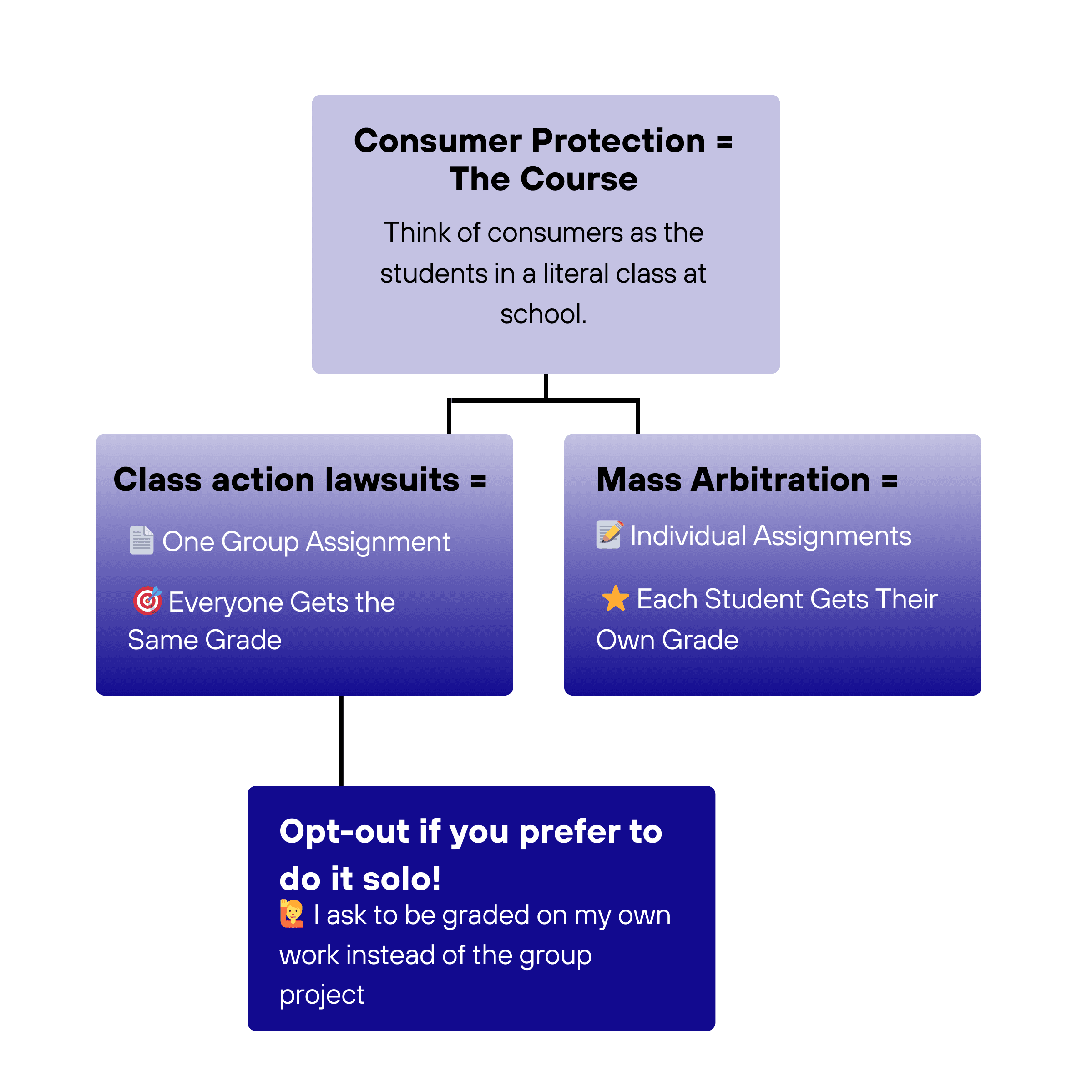
Think of a Class Action Lawsuit like a group project where everyone gets one shared grade. If the group misses the project deadline or the teacher decides not to grade it, the whole group fails the class. No individual do-overs.
Mass arbitration is different. It’s like each student submitting their own individual assignment, even though the class is taking the same course and following the same syllabus. Each paper is graded separately, on its own merits.
So even if the group project deadline has passed, that doesn’t stop you from turning in your own assignment, as long as you submit it before the real deadline for the course.
In legal terms, that “real deadline” is the statute of limitations. As long as your individual claim is filed before that deadline, it can still be reviewed, regardless of what happened with the class action.
What about Class Action Opt-Outs?
In some class actions, potential class members are automatically included unless they affirmatively opt out of the lawsuit. This means that if a consumer meets the eligibility criteria and does nothing, they're considered part of the class. Individuals may choose to opt out, which means they are choosing not to participate in the class action lawsuit.
Back to our classroom analogy, this is similar to participating in a course where the grade is USUALLY based on a group assignment, but a few students tell the teacher they would rather be graded on individual assignments. If this is decided, they won't fail the course! Those students are just choosing to be graded on their own merits instead. Because they've made this arrangement, they don't need to worry about the outcome of their group's assignment or the deadline for those projects.
Consumers may choose to opt-out of a class action lawsuit because:
They want to retain their right to sue individually or through mass arbitration
They believe the class settlement is too small or unfair
They have suffered more severe or unique harm than the average class member
They prefer individual outcomes rather than a one-size-fits-all approach.
Opting out allows for flexibility. It does not commit you to arbitration, but it does keep that option open.
Why You Might See Both Involving the Same Company
Large companies regularly face multiple legal actions at the same time.
Court-based class actions can exist alongside:
Individual arbitration claims
Mass arbitration filings
Other disputes involving different time periods or conduct.
Similar allegations do not mean the cases are legally connected or mutually exclusive!
The Key Takeaway
Noticing that a class action deadline has passed against a company that Chariot has an active claim for does not mean that our active claims regarding mass arbitration cases are invalid or closed - in fact, just the opposite!
Mass arbitration often remains a valid option for consumers before or after class action deadlines pass. Many consumers even prefer this route because it offers them more control, individualized consideration, and potentially stronger outcomes than a one-size-fits-all class settlement. Understanding the difference helps you make informed decisions rather than assuming it is already too late.
Consumers can view active mass arbitration claims at app.chariotclaims.com or request a case review by emailing support@chariotclaims.com.
Education
Know Your Rights


Chariot Claims does not provide legal advice. We are not attorneys. The information and services we provide should not be used as a substitute for legal advice. For specific legal concerns, we strongly recommend consulting with a qualified attorney. We expressly disclaim any liability related to actions taken or not taken based on our services or the information we provide.
Participation in settlement relief does not require signing up for third-party services. No-cost filing and support may be available from the claims administrator and class counsel. Those signing up for and authorizing Chariot Claims as their agent will receive comprehensive claim handling with the aim of securing the maximum settlement amount entitled.